A week ago, I had a mastoidectomy on my right ear.
Long-time readers might know that 40 years ago (wow, is it really that long?!) I had a mastoidectomy on my left ear. So now I have a matched set.
In each case, the surgery was to remove a cholesteatoma. You can read the wikipedia article, but the short version is that it’s just like an ordinary inoffensive skin tag, but one that happens inside the middle ear. While a skin tag on your arm is harmless, though, in the middle ear it causes two main problems. One is that it crowds out the functions of hearing by encroaching on very limited space. The other is that skin is constantly shedding cells, and in the middle ear they have nowhere to go, so they sit there and become erosive, possibly destroying the ossicles (hearing bones) and surrounding tissue.
In 1984, when I had the first one, it had gone long enough that it destroyed the middle ear entirely, leading to much further drama and shenanigans. This time, around, hopefully, it’s been caught early enough that my hearing can be salvaged.
So, on Thursday morning (June 13), I went in to the UK hospital, where they performed the surgery. I remember being wheeled into the operating room. I have a very fuzzy recollection of Maria asking where I had put my hearing aid (that was, apparently, about 4 hours later) and I remember getting into bed (another 3 or 4 hours later), and the rest of Thursday, and almost all of Friday, I have no memory of at all. Saturday and Sunday are a bit of a fog too.
The surgery ended up removing about half of my right ear drum. Also, the stapes (one of the ossicles) has been replaced by a 3d printed titanium replica, which is apparently a new enough thing that the surgeon was pretty geeked about it!
He built a “scaffolding” of cartilage (I’m not entirely sure what that means) so that the ear drum can grow back in the right place and shape.
Now, a week later, I’m starting to feel a little stronger. At the moment, I have almost zero hearing in my right ear, and am relying entirely on my BAHA in my left ear. I *think* that the hearing will improve as the swelling goes down. At least, I am trying to persuade myself that I believe this.
It’s very very hard to be patient, and this is all profoundly discouraging and, to be honest, more than a little terrifying. Losing a primary sense is a very frightening thing, especially when it’s been pretty tenuous for most of my life.
It’s also hard to find words to describe adequately that while I cannot hear anything in my right ear, nevertheless sounds cause pain in my right ear. There are many things about being hearing impaired that are difficult to describe to those with perfect (or, at least, better) hearing. I have spent 40 years trying to come up with adequate analogies, and still haven’t really found them.
What I described to Maria yesterday is that when I’m listening to speech, it’s like I’m reading, but the book is being moved around randomly. And occasionally there will be a flash of bright light (ie, a loud noise) that temporarily “blinds” me and it takes a moment to regain the sense of the words. This means that I’m always concentrating hard when trying to follow a conversation, especially when several people are speaking at once.
Weird that I’m in a profession where attending events in loud crowded rooms is such a big part of my life.
My ears are very sensitive to loud noises, but at the same time I cannot discern meaning from speech much of the time, and have to concentrate and derive meaning from other clues, such as context and lips movement. It’s … complicated.
Anyways, if I seem standoffish over the coming months, I’m just trying to navigate my new hearing situation. I really hope it improves dramatically as the inflammation goes down and the ear drum recovers. But I expect that for the next several months I’m going to avoid noisy situations as much as possible. The next conference I’m committed to is in September, so hopefully by then I’ll have some clearer idea of what my new normal is.
UPDATE: Day 11

 I’m pretty sure it was taken by Chris Davis. It’s me and Ken Coar riding up in the elevato at ApacheCon Stuttgart in 2005.
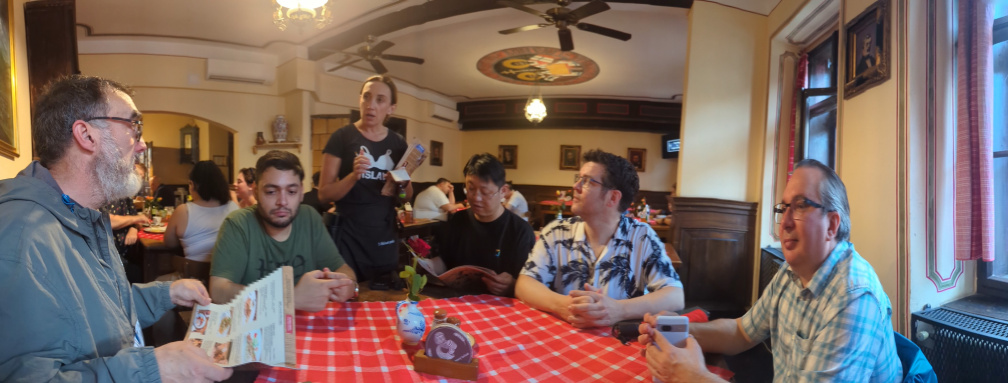 I was there too, but I didn’t include myself.
 This is another of my favorite ApacheCon pictures. (